


The Journey So Far
1810

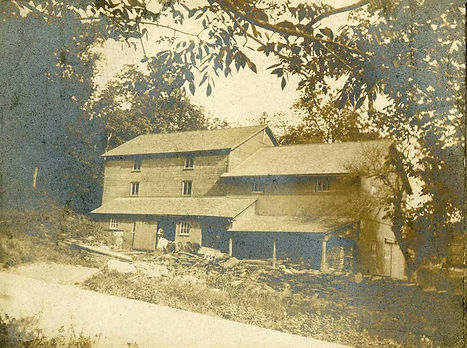
Aaron Fay built a steam operated saw and grist mill in the hamlet of Taunton, New York
.jpg)
1868

Hart Abbe and his wife, Catherine, sold the property to John L. Willcox for $9,000.
1870
Willcox passed the property to his sons, Charles and Edgar.
.jpg)
A Dunning & Boschert Press Co. cider press is added.
1884
Widowed, Catherine Abbe deeded a bordering strip of land to Charles Willcox for the consideration of $1.00.
1917


1922
Upon his death, Charles' niece, Minnie Morrison Hobbs (1879-1954) was willed the property. The land and its surroundings became known as the "Hobbs Tract" to the present day.
Hobbs sold the mill to Benjamin Morey (1888-1928) and Katherine Schneider Morey (1891-1993).
1923


_edited_edited.jpg)
1924
An advertisement in "The Outlook", the annual publication of Split Rock High School.


The "little house" was built. According to Howard Morey's memoir, "it was 24 foot square with two bedrooms, kitchen, dining room and an upstairs with a slanted roof that was never finished off but where we three boys slept."
1925

Benjamin found the original 1884 cider press for sale in the valley and returned it to its home and existing foundation at the Mill.

Katherine became the first Receiver of Taxes of the Town of Onondaga. She had to personally visit community property owners to collect their cash payments. She used a large satchel for the monies she received and carried a gun to protect herself from thieves.
1927


Looking east down Fay Road. The house on the right was the Fay Homestead.The new house next to The Mill (on the left beyond the white fence) was a "kit" home- the pieces of which came by rail. It is now called "The Cider Bungalow"


Benjamin Morey succumbed to pleurisy, leaving widow Katherine with their flourishing business and four small children. As a descendant of the Luchsinger family, Katherine was no stranger to hard work and carried on.
1928

Katherine is elected town clerk and conducts business from a tiny building adjacent to the mill near the road. She adds farm machinery, lawn mower and snow blower sales and service, a bakery and a fish fry to the operation.

1929


1939
Katherine Morey, son Howard Morey, Lincoln Keehfus, Carl

Harold Shuart and his six-horse team that was used for advertising in Syracuse and at the New York State Fair. At one time, they delivered barrels of sweet cider on this wagon to a bar in Armory Square where it was fermented to hard cider


1941


Fay Road was previously called Grand Ave Road,


No doubt, a day like this inspired the sophisticated irrigation system that still exists on the property


Well deserving, Katherine retired from her town position. Her sons, Gwynn and Howard continued the business.
1957


The entire mill was lost in a devastating fire. The little clerk’s office is dragged to the rear of the property and attached to Katherine’s house.
1962


1963
A new structure was built, facing east


1975
Howard Morey retires.
1985
Gwynn sells the mill to Michael Brady

1989
1990
Two kids from the valley, Dan Seeley and Teresa Cortese meet and fall in love.

1991


1993
1994
With a passion for cooking and entertaining, the Seeleys began catering for friends, working out of a tiny kitchen in their Seneca Turnpike home.
1995
Local real estate investors and owners of Onondaga Paper and Twine, the Talev brothers buy the bank-owned property and rent it out.
Dan and Teresa move their family to a home in the Winkworth area. They continued to work their "real" jobs as the catering business grew.


1997

Several restaurants came and went at the Fay Road property.
1999
Following a lifelong passion, Dan quit his corporate job and began work as a chef at Kelley's Restaurant. He and Teresa continued catering for fun.

1998

When their first corporate client asked for an invoice, a name had to be chosen for the catering company. "Diamond Dan" (as he was affectionately known by some of his friends) and Teresa thought "Diamond Catering" would convey a sense of quality and longevity.
Their first business cards were printed at home where Teresa attached magnetic backings and tiny gems onto each one.

Friends, family and neighbors enjoyed the Seeleys' passion for entertaining

The Seeleys convert their garage into a commercial kitchen. Their next-door-neighbor volunteered to wash dishes at the end of many a long day in exchange for leftovers. It was all-hands-on-deck in those days. Dan's mother watched the babies and Teresa's mother prepped vegetables, ran errands or set tables.
2000


2002
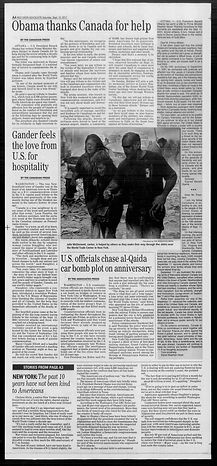
While watching a special broadcast about the events of 9/11, The Seeleys learned of the selfless acts by the people of Newfoundland when thousands of airline passengers were diverted there. Dan casually commented that "someone should throw those people a party." Soon after, the comment became a commitment and plans began for a life changing trip. The project was dubbed "Gratitude for Gander".
Dan left Kelley's to cater full time.


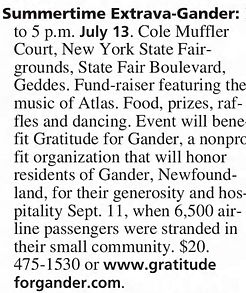
Numerous fundraising events were underway. Without the benefit of today's social media platforms, the Seeleys used their resourcefulness to raise money and find volunteers. A presentation in front of a local Rotary Club seemed a terrifying endeavor. Little did they know that they would soon be interviewed live on CNN.
One of the reasons the Seeleys pushed forward with their efforts, despite numerous rejections and challenges, was the desire for Newfoundlanders to be recognized for what they did. They were shocked to not hear of it until 2002. It would not be until December, 2004 before our then President publicly thanked them.


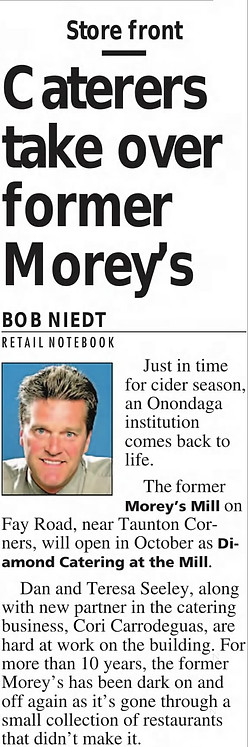
Diamond Catering moves into the mill. When the Seeleys introduced themselves to Gwynn Morey, who lived a few doors down the street, his wife, Elizabeth met them with a very stern warning saying that they'd better know what they were doing. She had witnessed a series of restaurants come and go over the years and was heartbroken at the state of the building. Renovations began immediately.
2003




2005
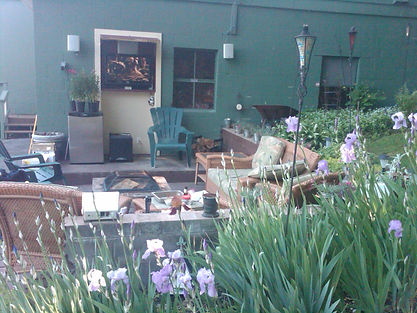
The Seeleys moved their family of five plus two cats and a dog into the tiny house behind the Mill. The patio provided a little extra living space when weather allowed. It allowed them to grow their babies and their business at the same time.
2006


A Tully fundraiser for Olympian Lopez Lomong, a former "lost boy" of Sudan. The Seeleys prepared food for the huge crowd supporting Lopez' parents' trip to Beijing to watch him compete. During the event, Lopez called to say he would have the honor of carrying the American flag in the opening ceremonies.
2008
2022
Gwynn's last visit to the Mill before moving to Michigan to be closer to his daughter.
